Table of contents
It only takes a few seconds for a first-time kitesurf student to decide whether they feel safe, capable, and ready to try, and across the industry, schools are increasingly judged on those first “contact moments” as much as on lesson packages and locations. Instructors sit at the center of that make-or-break window, translating wind theory into trust, and nerves into movement. What looks like a simple first session is often a carefully engineered sequence of checks, cues, and micro-decisions that can turn hesitation into a breakthrough.
Before the kite, the trust check
Everyone remembers the first pull. What many forget is that the lesson really begins earlier, with a quick read of the person in front of you, and an unspoken question that hangs over the beach: will this feel controlled? Instructors who consistently produce confident beginners tend to start by shrinking the unknowns, they explain the plan in plain language, they establish clear stop signals, and they normalize fear without feeding it. That emotional framing matters because kitesurfing is not a sport where you can “wing it”, the power of the kite is real, and risk management has to be understood, not merely recited.
Good schools operationalize this with routines that look simple, yet carry real outcomes: equipment sizing based on rider weight and wind strength, a conservative first-kite choice, and a strong emphasis on launch and landing discipline. In many training systems, students are introduced early to the concept of a “wind window”, plus the safety systems on modern kites, including quick-release mechanisms and leash behavior, because the safest first lesson is the one where the student knows exactly what to do if something goes wrong. Industry data reinforce why that matters: the most commonly cited injury mechanism in kitesurfing remains being dragged or lofted by the kite, often near shore, and often during launch or landing; a frequently referenced review in Sports Medicine (2015) described injuries in the sport as typically traumatic, with patterns linked to high-energy events and environmental factors, rather than overuse. The practical takeaway is straightforward: the “trust check” is not a soft skill, it is the first layer of risk reduction.
Micro-coaching: the breakthrough engine
Progress is rarely linear. The first lesson is a cascade of tiny wins, and the instructor’s job is to make those wins arrive fast enough to keep motivation high, while keeping the pace slow enough to preserve safety. That is where micro-coaching becomes the breakthrough engine, because beginners do not need more information, they need fewer, clearer cues delivered at the right moment. The difference between a stalled session and a confident body-drag is often one sentence, timed properly, with the right emphasis: shoulders down, look where you want to go, breathe, hands centered.
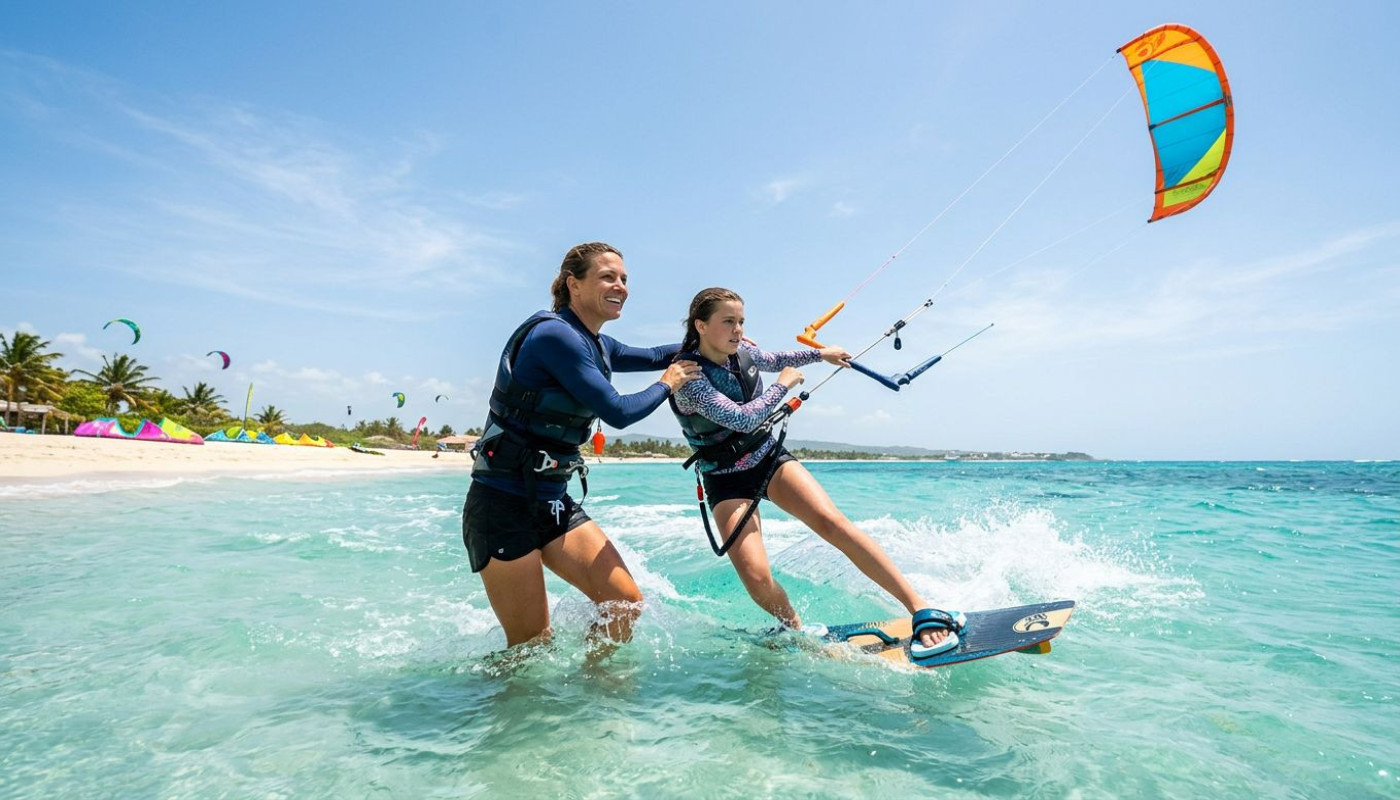
This is also where contact moments become highly technical, even if they do not feel that way to the student. Instructors watch hand position, bar pressure, and where the eyes go under stress, because beginners tend to look at the kite and forget the board, or fixate on the board and forget the kite. They correct the sequence, not just the outcome, and they create “fail-safe drills” that allow mistakes without penalty, such as controlled kite dives, one-handed flying, and body-dragging upwind before any board start is attempted. Modern teaching methods lean on structured progressions and real-time feedback, and in many destinations, radio helmets and boat support are becoming common for water-based stages; when used well, they reduce delays, prevent repeated errors, and keep students inside safe corridors.
For readers considering their own first steps, the most telling sign is whether the program is built around progression rather than bravado. Reputable operations typically foreground safety briefings, clear wind limits, and instructor-to-student ratios, and they make sure the basics are locked before adding complexity. If you are looking to learn kitesurfing, look for an approach that treats early wins as deliberate milestones, not as lucky accidents, because the confidence you gain in the first hour will shape every session that follows.
Safety is a choreography, not a checklist
Beach scenes can be deceiving. A shoreline full of kites suggests freedom, yet the invisible structure behind safe sessions is closer to choreography, with strict sequencing and role clarity. Instructors manage traffic, wind shifts, and student spacing, they choose training areas that reduce consequences, and they enforce conservative decisions when conditions deteriorate. This is not about being cautious for caution’s sake, it is about recognizing that many severe incidents occur in the first meters of a session, not kilometers offshore, and that beginner errors are most dangerous when paired with obstacles, crowds, or gusty winds.
Weather assessment is part of that choreography, and it is more nuanced than simply checking a forecast app. Instructors consider wind direction relative to the shoreline, the likelihood of sudden squalls, and the presence of turbulence from buildings, cliffs, or trees, plus the strength of currents that can turn a small drift into a long retrieval. Training locations matter, too: wide beaches, clean wind, and shallow, forgiving water can dramatically reduce the risk profile, especially for the earliest water starts. The International Kiteboarding Organization (IKO), one of the best-known global training frameworks, emphasizes standardized safety procedures and structured skill levels, precisely because consistency reduces the chance that a beginner will be asked to do too much too soon. Insurance requirements in many regions reinforce the same logic, pushing schools to document their methods and keep equipment within service schedules.
Equipment itself has evolved toward safety, and instructors who know how to leverage that evolution can transform a lesson. Most contemporary kites include depower systems that let riders reduce pull by sheeting out, and quick-release designs that, when practiced, can be activated under stress. Harness fit, line length, and board size are not trivial details, they change the learning curve and the margin for error, and the instructor’s choices here often determine whether a student spends the session fighting the kite or learning to pilot it. The safest lesson is usually the one that feels calm, even when the wind is not.
What first-time students should demand
Choosing a school is a consumer decision, and like any service purchase, it pays to ask pointed questions. A first-time student should not be embarrassed to inquire about instructor certification, typical ratios, rescue support, and the conditions under which lessons are postponed. The best operations answer quickly and specifically, and they explain their reasoning without defensiveness, because they have already thought through their risk boundaries. If the response is vague, or if the focus is only on adrenaline and speed of progression, that is a warning sign.
There are also practical signals on the beach. Does the instructor run through safety systems and have the student practice them on land, or is it rushed? Is there a clear plan for what happens if the wind drops, spikes, or changes direction? Are helmets, impact vests, and appropriate wetsuits available, and is the launch area controlled rather than chaotic? Kitesurfing is intensely physical, yet it is also cognitively demanding at the start, and fatigue can cause errors; quality instruction accounts for this by building in rest, hydration, and short debriefs that consolidate learning. Many schools now structure sessions so that the first lesson focuses on kite control and body position, then progresses toward board starts only when the student shows reliable control, which is a far better predictor of future success than simply “standing up once”.
Budget and scheduling also shape outcomes more than people expect. Private lessons cost more, but can accelerate progress and reduce time spent waiting, while small-group formats can be effective if ratios stay low and the spot is forgiving. Prospective students should look for transparent pricing that includes equipment, safety gear, and any boat support, and they should be realistic about the number of sessions needed: for many beginners, mastering consistent water starts and short rides takes multiple lessons, depending on wind quality, fitness, and coordination. The breakthrough is real, but it is usually earned through repetition.
Planning your first session, realistically
Book early during reliable wind seasons, and keep flexibility for weather-driven rescheduling. Expect to budget for more than one lesson, plus gear rental if you plan to practice, and check whether local sports clubs or tourism programs offer discounts or beginner packages. If you are traveling, prioritize schools that provide rescue support and clear safety briefings, because that structure is what turns first contact into lasting progression.
Similar articles


